

Why Hyperlocal Listings Generate Higher Response Rates
Marketing works best when it feels relevant.
People respond when messages reflect their immediate needs, location, and context. Broad targeting may increase visibility, but relevance increases action.
That is why hyperlocal listings generate higher response rates compared to generic, wide-area listings.
When a listing speaks directly to a neighborhood or city block, it feels personal rather than promotional. Buyers pay attention because the offer applies directly to them.
In this article, we explore how proximity, contextual relevance, trust, and buyer psychology combine to explain why hyperlocal listings generate higher response rates consistently.
Relevance Increases Immediate Engagement
Relevance drives response.
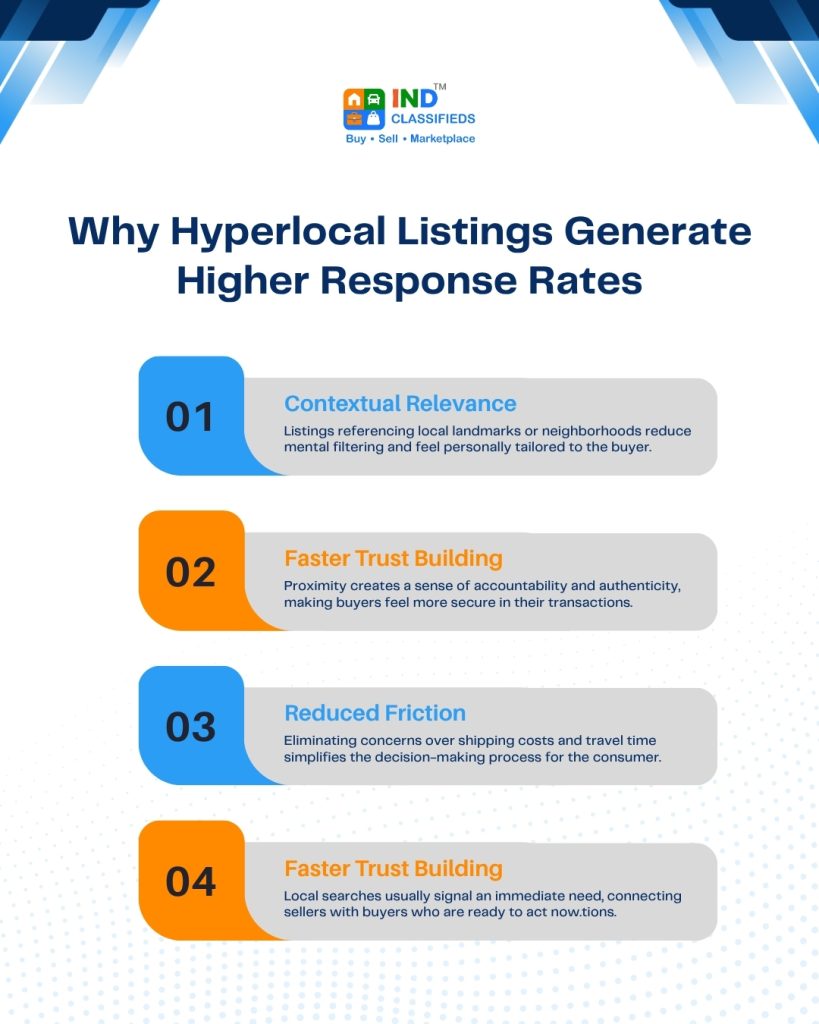
When users see listings within their immediate area, they perceive them as more applicable. Geographic specificity reduces mental filtering.
People are more likely to respond to something that feels close and accessible rather than distant and abstract.
Hyperlocal listings generate higher response rates because they remove the “not for me” reaction common with broad campaigns.
Want to learn how to find genuine buyers in your city quickly and safely?
Contextual Alignment With Daily Life
Buyers relate more strongly to listings that reference familiar streets, neighborhoods, or local landmarks.
This familiarity builds immediate recognition. Recognition increases comfort, and comfort increases engagement.
Reduced Cognitive Effort
Broad listings require evaluation. Buyers must consider distance, shipping, and logistics.
Hyperlocal listings simplify decisions. The fewer factors buyers must analyze, the faster they respond.
Proximity Builds Trust Faster
Trust forms more quickly when proximity exists.
When listings are tied to specific communities, they appear more authentic. Buyers feel that sellers are reachable and accountable.
That psychological reassurance directly supports the idea that hyperlocal listings generate higher response rates.
Shared Community Signals
Local identity creates subtle credibility markers. Mentioning neighborhoods, nearby transit points, or community references strengthens legitimacy.
These signals reduce skepticism and increase interaction.
Want to understand how local selling helps you close deals faster?
Accountability Encourages Replies
Buyers feel more secure responding to someone within their own city.
The possibility of direct communication or in-person interaction builds confidence. Confidence increases response behavior.
Immediate Utility Drives Faster Action
Hyperlocal marketing succeeds because it connects with real-time needs.
When someone searches for a service or product locally, they often require it soon. The intent is immediate rather than exploratory.
Listings that match this urgency naturally receive stronger engagement.
Primary keyword: hyperlocal listings generate higher response rates
This phenomenon occurs because proximity aligns need and availability. When urgency meets accessibility, action follows quickly.
Search Behavior Favors Local Results
Modern search behavior prioritizes location.
People include city names, neighborhoods, or “near me” phrases when looking for services. Platforms also prioritize local relevance in algorithms.
Listings optimized for hyperlocal visibility appear in front of motivated users.
Secondary keyword: local buyer engagement
Strong local buyer engagement stems from relevance. When users see listings tailored to their area, interaction rates increase naturally.
Less Competition Means Greater Visibility
Wide geographic campaigns face intense competition.
Hyperlocal targeting narrows the field. Fewer sellers compete for attention within a defined radius.
This concentrated exposure increases the probability of interaction.
When visibility improves within a smaller audience, hyperlocal listings generate higher response rates consistently.
Emotional Familiarity Encourages Participation
People trust what feels familiar.
Seeing a listing connected to one’s neighborhood builds a subtle emotional link. It feels less transactional and more community-oriented.
This emotional comfort encourages inquiries and messages.
Primary keyword: hyperlocal listings generate higher response rates
The emotional layer is often underestimated, yet it plays a major role in driving responses.
Real-Time Community Relevance Enhances Impact
Local events, seasonal changes, and community trends influence buying behavior.
Hyperlocal campaigns can align with these shifts effectively. Listings that reflect current local circumstances feel timely and relevant.
Timeliness increases urgency and boosts response rates.
Secondary keyword: community-based marketing
Community-based marketing works because it speaks directly to shared experiences. When listings reflect local context, engagement grows organically.
Simplified Logistics Improve Conversion
Distance complicates transactions.
Shipping fees, delivery delays, and return concerns create friction.
Hyperlocal listings eliminate many of these obstacles. Buyers feel reassured knowing exchanges can happen quickly and directly.
Reduced friction increases willingness to respond.
Hyperlocal Listings Encourage Direct Communication
Local transactions often begin with simple conversations.
Buyers feel comfortable asking questions when the seller is nearby. That comfort increases message frequency.
Higher message frequency directly translates into stronger response metrics.
Primary keyword: hyperlocal listings generate higher response rates
This direct communication loop strengthens engagement and increases conversion potential.
Data-Driven Personalization Strengthens Results
Digital platforms now allow sellers to target by zip code or neighborhood.
This granular targeting increases precision. The more specific the targeting, the more relevant the listing appears.
Precision leads to stronger local buyer engagement and improved performance metrics.
Building Long-Term Community Presence
Hyperlocal strategies are not only about immediate results. They build sustainable presence.
Repeated visibility within a neighborhood increases familiarity. Familiarity increases trust.
Over time, response rates improve because recognition reduces hesitation.
Secondary keyword: hyperlocal advertising strategy
A strong hyperlocal advertising strategy focuses on consistent presence rather than sporadic outreach. Consistency builds credibility.
Reduced Noise Enhances Attention
In broad marketplaces, listings compete against thousands of alternatives.
Hyperlocal listings reduce noise. Fewer distractions increase the chance of meaningful engagement.
Focused visibility strengthens response behavior.
Primary keyword: hyperlocal listings generate higher response rates
When attention is not diluted, response improves naturally.
Buyer Intent Is Stronger Locally
Local searches often signal readiness to act.
When someone searches for a service within walking distance, they are closer to decision than someone browsing nationally.
High intent combined with proximity leads to quicker engagement.
This intent-driven behavior explains why hyperlocal listings generate higher response rates consistently.
Conclusion
Relevance drives action.
Hyperlocal listings align with buyer intent, reduce friction, and build trust through proximity. They feel accessible, credible, and timely.
By narrowing geographic focus, sellers reduce competition and increase visibility among motivated audiences.
If your objective is stronger engagement and better conversion metrics, adopting a hyperlocal advertising strategy offers measurable advantages.
Ultimately, hyperlocal listings generate higher response rates because they combine context, community, and convenience in a way broad campaigns cannot replicate.