


Why Hyperlocal Marketplaces Offer Better Deals
Online buying has changed how people discover products, services, and opportunities. Yet many buyers still struggle to find truly affordable deals on large marketplaces. Prices often increase due to shipping costs, commissions, and competition from distant selle rs.
Hyperlocal marketplaces are changing this experience. By connecting buyers and sellers within the same city or neighborhood, these platforms create an environment where deals become more practical and affordable.
Instead of searching across distant locations, buyers interact with people nearby. This proximity reduces cost, improves trust, and speeds up negotiations. In many situations, it also helps buyers discover products at prices far below national marketplace listings.
Understanding why hyperlocal marketplaces offer better deals requires looking beyond price alone. It involves convenience, transparency, demand patterns, and the natural efficiency of local buying ecosystems.
Proximity Reduces Hidden Costs
One of the biggest reasons hyperlocal marketplaces offer better deals is the reduction of hidden expenses.
Traditional e-commerce often includes shipping fees, packaging costs, platform commissions, and logistics expenses. These costs get added to the final price buyers see.
When buyers and sellers connect locally, most of these costs disappear. Products can be picked up directly or delivered nearby with minimal effort.
Lower overhead naturally leads to better deals for buyers.
Local Pickup Eliminates Shipping Expenses
Shipping fees can sometimes equal a significant portion of the product price.
In hyperlocal marketplaces, buyers usually meet sellers or arrange nearby pickup. The absence of courier charges allows sellers to price items more competitively while still making a fair return.
Direct Buyer-Seller Communication Improves Pricing
Large marketplaces often place layers between buyers and sellers. Automated systems, fixed pricing models, and platform fees reduce negotiation flexibility.
Hyperlocal marketplaces encourage direct conversations. Buyers can ask questions, clarify product condition, and negotiate fairly.
This direct interaction often leads to prices that benefit both sides.
Negotiation Creates Flexible Deals
Negotiation is a natural part of many local transactions.
When buyers and sellers communicate directly, they can adjust pricing based on urgency, demand, or product condition.
That flexibility is one reason hyperlocal marketplaces offer better deals compared to fixed-price online stores.
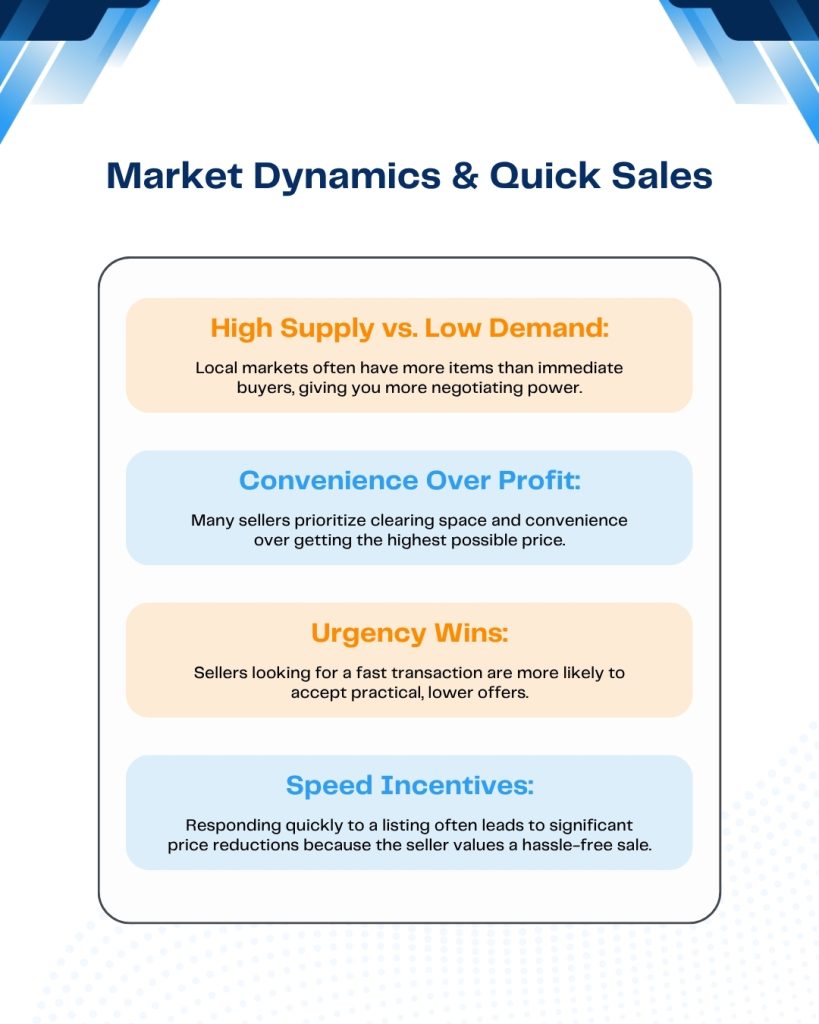
Local Supply Often Exceeds Immediate Demand
Local markets frequently contain items that owners want to sell quickly.
Unused electronics, vehicles, furniture, or household goods may no longer be needed. Sellers prioritize convenience over maximizing profit.
When supply exceeds local demand, buyers gain negotiating power.
This imbalance helps create better deals in hyperlocal marketplaces.
Urgent Sellers Accept Practical Prices
Sometimes sellers prefer quick transactions instead of waiting weeks for the perfect buyer.
Local buyers who respond quickly often receive significant price reductions simply because the seller values convenience.
Trust Improves Transaction Efficiency
Trust plays a major role in pricing decisions.
When buyers trust the seller, they are more comfortable making quick decisions. Likewise, sellers trust local buyers more because communication is easier.
This mutual confidence simplifies transactions and allows deals to close quickly.
Hyperlocal marketplaces build this trust naturally because users share geographic proximity.
Reduced Platform Fees Allow Lower Prices
Major marketplaces often charge sellers listing fees, service fees, or commission percentages.
These costs push sellers to increase prices.
Hyperlocal marketplaces usually operate with lower fees or simpler listing systems. Sellers do not need to inflate prices to cover heavy platform charges.
As a result, buyers often discover more affordable deals.
Faster Transactions Encourage Competitive Pricing
Speed influences pricing decisions.
When sellers know they can close deals quickly through a hyperlocal marketplace, they often price products attractively.
Competitive pricing attracts local buyers immediately and increases the likelihood of a fast sale.
Quick Sales Motivate Better Offers
Sellers frequently lower prices when they know a buyer can complete the purchase quickly.
Local buyers can inspect products, negotiate, and finalize the transaction within hours or days rather than weeks.
This quick turnaround encourages sellers to offer better deals.
Buyers Discover Unique Local Opportunities

Hyperlocal marketplaces also provide access to products that may never appear on national platforms.
People often list items casually within their local area. These items may include lightly used appliances, vehicles, furniture, or specialized tools.
Because the seller’s goal is convenience, the price is often significantly lower than retail value.
Community-Driven Markets Promote Fair Pricing
Local communities create natural accountability.
Sellers prefer fair pricing because reputation matters in a neighborhood environment. Buyers also respect reasonable offers, creating balanced negotiations.
Over time, this dynamic leads to a healthy ecosystem where hyperlocal marketplaces consistently offer better deals.
Reputation Influences Pricing Behavior
In local environments, sellers understand that unfair pricing discourages buyers.
Maintaining positive relationships within the community encourages honest pricing and transparent transactions.
Better Deals Come From Reduced Competition
Large online marketplaces expose sellers to nationwide competition. Prices become influenced by distant markets with different cost structures.
Hyperlocal marketplaces limit competition to nearby sellers.
This localized competition creates realistic pricing aligned with local demand rather than inflated national benchmarks.
Why Hyperlocal Marketplaces Continue to Grow
Consumer behavior is shifting toward convenience and immediacy.
Buyers want faster transactions, easier communication, and lower costs. Hyperlocal marketplaces deliver exactly that.
As more people recognize the value of buying locally, these platforms are becoming a preferred option for everyday purchases.
From electronics and vehicles to furniture and services, local platforms are reshaping how people find affordable deals.
Conclusion
Hyperlocal marketplaces are transforming the way buyers and sellers interact. By focusing on proximity, these platforms remove many barriers that increase prices in traditional online marketplaces.
Lower logistics costs, direct negotiation, reduced platform fees, and stronger community trust all contribute to better deals.
Buyers benefit from affordable pricing and quicker transactions, while sellers gain convenience and faster sales.
As digital platforms continue evolving, hyperlocal marketplaces are likely to play an even bigger role in helping people find practical, cost-effective deals within their own communities.


